Why weight is such an important indicator in parrots
In the wild, a bird that shows weakness becomes an easy target for predators and may lose its position in the flock. Masking illness is therefore an instinct, and companion parrots have kept it. A parrot can behave almost normally while a health problem has been developing for days or weeks.
Weight is one of the few objective, early warning signs available at home:
- it changes before visible symptoms in many illnesses
- it can be measured precisely, in grams
- it can be tracked over time and compared
Small changes cannot be seen by eye
The catch is that small changes cannot be seen by eye. A 10% loss in a 450-gram African grey is about 45 grams, a change that feathers hide completely. Without a scale and a record, it usually goes unnoticed until the bird is visibly unwell.
Typical weight ranges by species
The table below lists typical adult weight ranges for popular companion species, ordered from lightest to heaviest. Weight is measured in grams, the standard unit in avian care worldwide.
Why the species range is only a starting point
The ranges below are wide, and that is not a flaw; it reflects reality. Within one species, healthy individuals differ by sex, subspecies, age and simply by skeletal frame. A cockatiel that is stable at 85 g may be in perfect condition, while another at 110 g may be equally healthy.
That is why the most important reference is not the species average but your bird’s own baseline: the weight at which it remains stable over the long term while the bird is active and in good condition. The species range tells you the ballpark. The individual baseline tells you the truth.
A baseline is established the same way it is used: by regular weighing over weeks and months, ideally with notes on moulting, season and diet changes.
What weight changes mean
Not every movement on the scale is a reason for concern. It helps to distinguish three situations.
Normal fluctuation. A parrot’s weight naturally swings by a few percent within a single day: a full crop after feeding, droppings, activity and time of day all play a role. Mild seasonal variation, changes during a moult and hormonal changes (for example in hens before egg-laying) are common as well.
A trend that deserves attention. The important signal is not one lower reading but a sustained downward trend across days or weeks. In avian care literature, a sustained loss of around 5% of body weight is commonly cited as a point where the keeper should pay close attention and contact an avian veterinarian.
A reason to see a vet. A loss of around 10% or more from the bird’s usual weight is commonly considered a reason for a veterinary visit even if the parrot otherwise looks fine. A rapid loss combined with other signs such as a fluffed-up posture, unusual quietness or reduced appetite warrants prompt veterinary attention.
Weight gain matters too. Obesity is common in companion parrots, especially on seed-heavy diets, and increases the risk of fatty liver disease. A gradual long-term gain is worth discussing at a check-up.
How to weigh a parrot correctly
A meaningful weight record depends on consistency. The number itself matters less than the conditions being the same every time.
- use a scale that measures in grams, ideally with 1 g resolution (0.1 g is better for small species)
- weigh at the same time of day; the standard is in the morning, before the first feeding
- use a perch mounted on the scale and tare (zero) it before the bird steps on
- record every measurement; a number without a log has little value
- weigh daily if possible; for small species in particular, a weekly weigh-in can miss a fast decline
A single measurement versus a long-term trend
One weighing shows only the current state. The real information is in the trend. A decline of one gram per week is invisible day to day, but on a chart covering two months it is unmistakable. A long-term record also shows recovery after an illness, the response to a diet change, and the bird’s normal seasonal pattern, so the keeper learns what is usual for this particular parrot, not for the species in general.
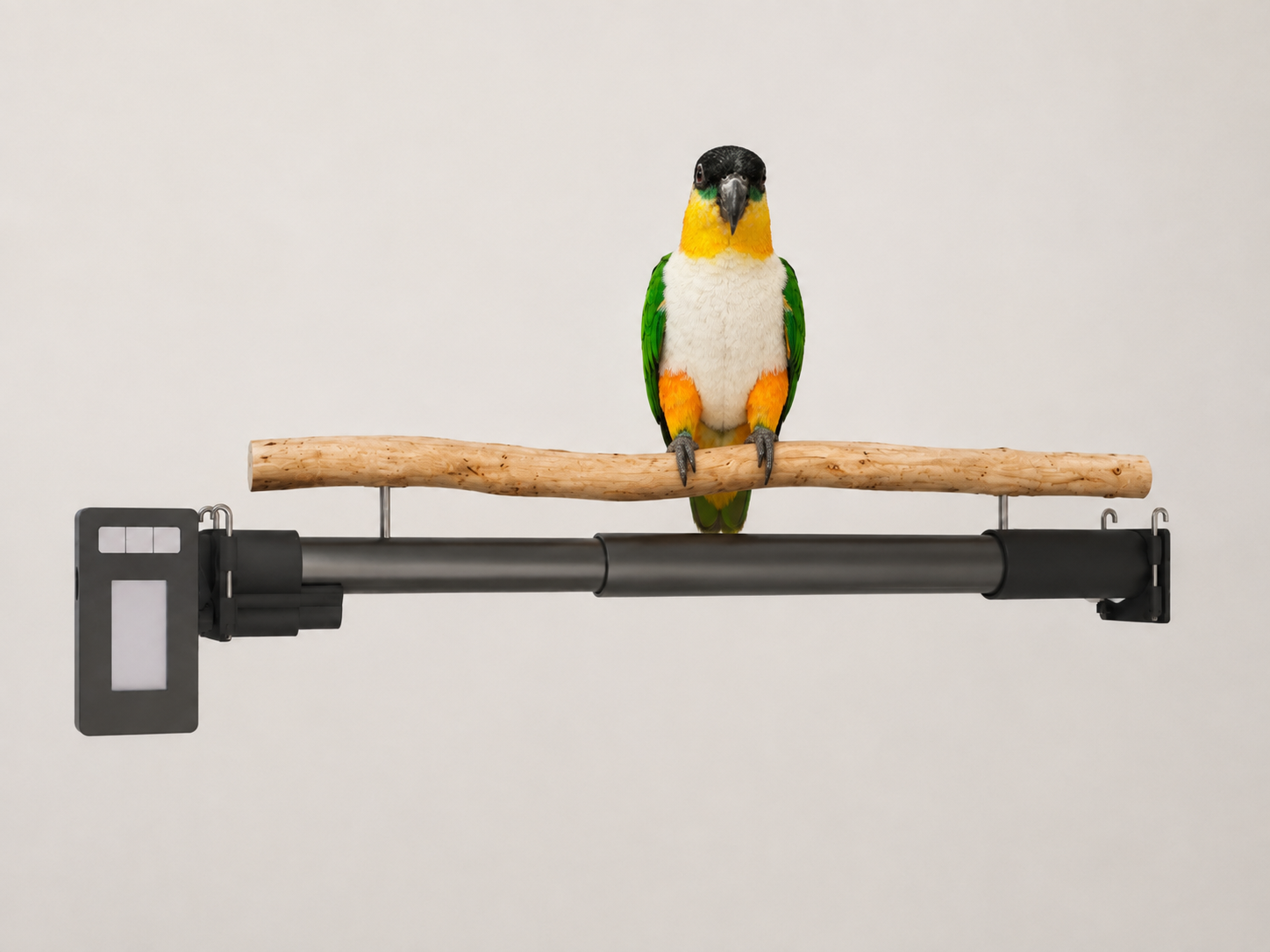
LoroBot weighs automatically: every landing, every day
Manual weighing is valuable, but it depends on routine and on the parrot’s cooperation. LoroBot removes both obstacles: the perch itself is the scale. The system records the parrot’s weight every time it naturally lands, without catching, towelling or interrupting its day.
From these measurements LoroBot builds the bird’s individual baseline and watches how it develops. And because the same device also monitors the environment, weight can be viewed in context on a single timeline:
- weight trend and perch visit frequency
- temperature and relative humidity
- CO2 concentration and air exchange
- day and night lighting pattern
Automatic alerts instead of constant checking
The point is not to flood the keeper with numbers. LoroBot evaluates the data and alerts only when something unusual happens, for example when:
- the weight trend starts declining beyond normal daily fluctuation
- the parrot visits the perch noticeably less often than usual
- environmental conditions leave the set range
Conclusion
Body weight is one of the earliest and most objective health indicators a parrot keeper can track at home. Species ranges provide useful guidance, but the real reference is the bird’s own long-term baseline, and that only emerges from regular, consistent measurement. LoroBot builds this record automatically with every landing on the perch and connects it with the environment, so the keeper gets not just a number, but context and an early warning when the trend changes.
Typical adult weight ranges for commonly kept parrot species
| Species | Typical adult range | Note |
|---|---|---|
| Budgerigar | 25–40 g | English/show budgerigars can weigh noticeably more |
| Lovebird | 42–60 g | Peach-faced; Fischer’s tend to be slightly lighter |
| Green-cheeked conure | 60–80 g | |
| Cockatiel | 75–120 g | |
| Quaker (monk) parakeet | 90–140 g | |
| Sun conure | 100–130 g | |
| Indian ringneck parakeet | 100–140 g | |
| Senegal parrot | 110–170 g | |
| Caique | 140–180 g | |
| Galah (rose-breasted cockatoo) | 270–350 g | |
| Timneh African grey | 275–375 g | |
| Amazon parrot | 350–500 g | Blue-fronted; larger Amazon species can exceed this |
| Eclectus | 380–550 g | Females are often heavier than males |
| Congo African grey | 400–550 g | Individuals vary widely |
| Umbrella cockatoo | 450–650 g | |
| Blue-and-gold macaw | 900–1,300 g | |
| Scarlet macaw | 900–1,100 g | |
| Green-winged macaw | 1,050–1,700 g | |
| Hyacinth macaw | 1,200–1,700 g |
These ranges describe typical healthy adult birds. They are guideline values, not veterinary standards for an individual parrot.
Frequently asked questions
How often should I weigh my parrot?
Ideally daily, under the same conditions; the morning before the first feeding works best. If daily is not realistic, aim for at least two to three times a week. Adult birds hold a fairly steady weight, so a consistent record makes even small deviations visible early.
How much weight loss means my parrot should see a vet?
Daily swings of a few percent are normal. A sustained loss of around 5% deserves close attention and a call to your avian veterinarian; a loss of around 10% or more is commonly considered a reason for a visit even if the bird looks fine. These are reference values from avian care literature, not a diagnosis.
Why does my parrot’s weight change during the day?
A full crop after feeding, droppings and activity all move the number by a few percent within a single day. That is why measurements are only comparable when taken at the same time and under the same conditions, and why a long-term trend says more than any single reading.
Is weight gain also a problem?
It can be. Obesity is common in companion parrots, especially on seed-heavy diets, and increases the risk of fatty liver disease. A gradual long-term gain is worth discussing at a veterinary check-up. In hens, a sudden gain can also relate to egg development.
Does LoroBot weigh my parrot automatically?
Yes. The perch itself is a scale, so LoroBot records the weight every time the parrot naturally lands on it, without catching or stress. The system builds the bird’s individual baseline, connects it with temperature, humidity, CO2 and lighting, and alerts you when the usual trend changes.